
Comparing Pella Impervia and Fibrex Window Materials
Comparing Pella Impervia and Fibrex Window Materials
If you’re shopping for replacement windows in Texas, you’ll run into two composite materials again and again: Pella’s Impervia fiberglass and Fibrex from Renewal by Andersen. Understanding how they differ is worth your time for a simple reason; the material you pick determines how your windows handle 105-degree afternoons, sudden hailstorms and West Texas dust, and how much you pay up front. Read on and you’ll be able to ask sharper questions at every sales appointment and compare quotes line by line instead of taking either company’s word for it. Here’s the plain-English comparison from your neighbors at Pella of DFW.
What Is Pella Impervia
Impervia is a proprietary material developed by Pella, made from an ultra-durable fiberglass composite engineered to stand up to extreme conditions. Its strengths line up well with what Texas throws at a house. It resists warping, rotting and corrosion, and it handles wide temperature swings without breaking down, which matters when a February cold snap follows a week of 80-degree days. Its insulating properties help maintain consistent indoor temperatures, which may help reduce cooling costs through a long DFW summer. It needs very little upkeep thanks to its resistance to fading, chipping and peeling. And its clean, low-profile frames suit both contemporary and traditional homes.
What Is Fibrex
Fibrex is a composite developed by Renewal by Andersen that blends reclaimed wood fibers with thermoplastic polymers. It’s a credible material with real strengths of its own. Because it’s made partly from recycled content, it appeals to environmentally minded homeowners. It combines wood’s rigidity with plastic’s resistance to decay, warping and fungal growth. It insulates well, contributing to comfortable rooms and reasonable energy bills. And it can be molded into a range of shapes and sizes for different architectural styles.
Fibrex vs Impervia on Strength and Durability
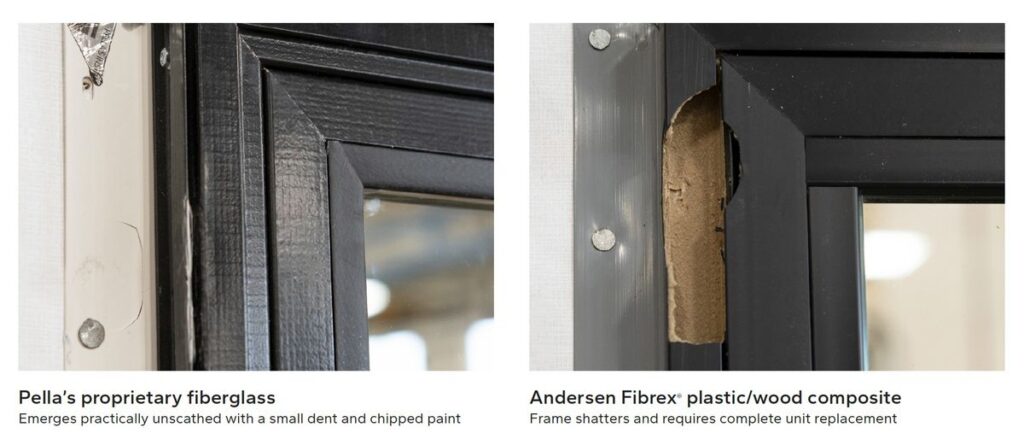
Both materials are engineered composites, but they’re built differently. Fibrex incorporates reclaimed wood fiber, while Impervia is a fiberglass composite that Pella describes as one of its strongest materials for windows and patio doors. In Pella’s published testing, Impervia fiberglass showed 7.8 times greater strength in a bend test, 73 times greater impact resistance and 19 times greater tensile strength than Fibrex. For homeowners between Fort Worth hail country and the wind-driven grit of Lubbock and Midland, those differences can matter when choosing a material built for demanding conditions.
Maintenance and Everyday Upkeep
Here the two are closer. Both are low-maintenance materials that never need painting the way wood does. Impervia resists fading, chipping and peeling and holds up through extreme heat and cold without melting or breaking down. Fibrex is also low-maintenance, though it may call for occasional cleaning and a bit more attention over its lifetime. Neither will have you out on a ladder every spring, which is exactly what most busy homeowners want.
Energy Efficiency and Environmental Impact
Fibrex’s recycled-content story is genuine and worth crediting. Impervia answers with efficiency credentials: depending on selections and attributes, it can be configured to meet ENERGY STAR guidelines in all climate zones. It comes standard with Low-E glass that can help reduce glare and heat gain, with optional upgrades such as foam-insulated frames and triple-pane glass. That heat-gain reduction matters in Texas, where cooling drives much of the energy bill.
What About Price
Affordability comes first for most families, so let’s be direct. Pricing for either material varies with window style, size, glass package and hardware, so no honest article can quote your project sight unseen. That said, comparable Impervia windows are generally priced similarly to Fibrex, with the final cost depending on the window style, size, glass package and hardware. On a whole-home replacement, that difference can vary by project, so it’s worth comparing quotes based on the specific products and options you choose.
Which Window Material Should You Choose
The right answer depends on your priorities. If recycled wood content ranks high for you, Fibrex deserves a look. If you weigh strength, weather resistance, low upkeep and price, Impervia fiberglass windows make a strong case, especially in a climate as hard on building materials as ours. Both insulate well; the differences show up in durability testing and on the quote.
Now you know what to ask when a salesperson sits at your kitchen table: how does the frame material perform in impact testing, what’s the recycled content, and what does the comparable window cost. The best way to settle it is to see and handle both style options in person. Stop by your local Pella Showroom in the DFW area to feel the difference in an Impervia frame yourself and talk through the right window or door for your home. Homeowners across DFW and West Texas, including Dallas, Fort Worth, Plano, Lubbock, Midland, Odessa, Abilene and Amarillo, are welcome. If a visit isn’t convenient, schedule a free, no-pressure in-home consultation instead. Call 682-205-2662 or contact us online.
Getting new doors is exciting, but there’s a lot to know! Get in touch with Pella Windows and Doors of Dallas/Fort Worth today and learn more about how a new front door can improve your home and the quality of your life.